
Can You Hold My Stick? (Copy)
The story behind our name, and the future we’re building By Kim Edwards, Executive Director, Hundred Acre Wood
If you spend a morning at Hundred Acre Wood, there is one phrase you will hear more than any other. A child, arms already overflowing with flowers and rocks and pinecones, holds up one more treasure and asks, with complete seriousness: can you hold my stick?
It is never just a stick. It is a wand, a weedwacker, a sword, a fishing rod, a treasure. It matters so much that it cannot possibly be left behind, and so it is handed to a teacher for safekeeping. Will it be forgotten about in ten minutes? Nine times out of ten, yes. But do we carry it? Yes. We do.
Because what we are really being handed is a child's imagination, running free. Our whole school is built around carrying that carefully.
People often ask about our name. Here is the story.
It started with a toddler and a log
Before Hundred Acre Wood was a school, it was a sleep-deprived mother going outside every day for her own sanity. When my son was one, he would use the logs in the forest to pull himself up to standing, and the texture of the bark would fascinate him. Nature literally held him up. The crunch of the leaves, the puddles, the sticks - it was the easiest, no-cost environment with the perfect level of stimulation for both of us. There was nothing he could break, no traffic to run into, his falls were cushioned, and it recharged my soul.
It made me wonder: why on earth wouldn't we just bring all the toddlers to the forest, for everyone's benefit?
Around that same time, we had pulled our childhood copies of the classic Winnie-the-Pooh books off the shelf to read to our firstborn - the original stories, with the original line drawings. And in the forest, I could see Pooh in my son: the innocence, the curiosity, the way he wandered. We even had our own spots we would stop at to play, the way the stories have Pooh's house and Owl's house and the Six Pine Trees. I was also reading The Tao of Pooh at the time, and I was captivated by the way Pooh, in the most simple and tangible way, teaches a grounded and present way of living.
So the name was never really a decision. By the time I stood up at a town hall meeting at the Marsh Street Centre in 2018 - a meeting about the childcare crisis in the Town of the Blue Mountains - and heard myself promise a room full of people that I was going to start a nature-based childcare facility, Hundred Acre Wood already existed. It just didn't have an address yet. Facebook still shows me the memory of that night every year. It was the point of no return.
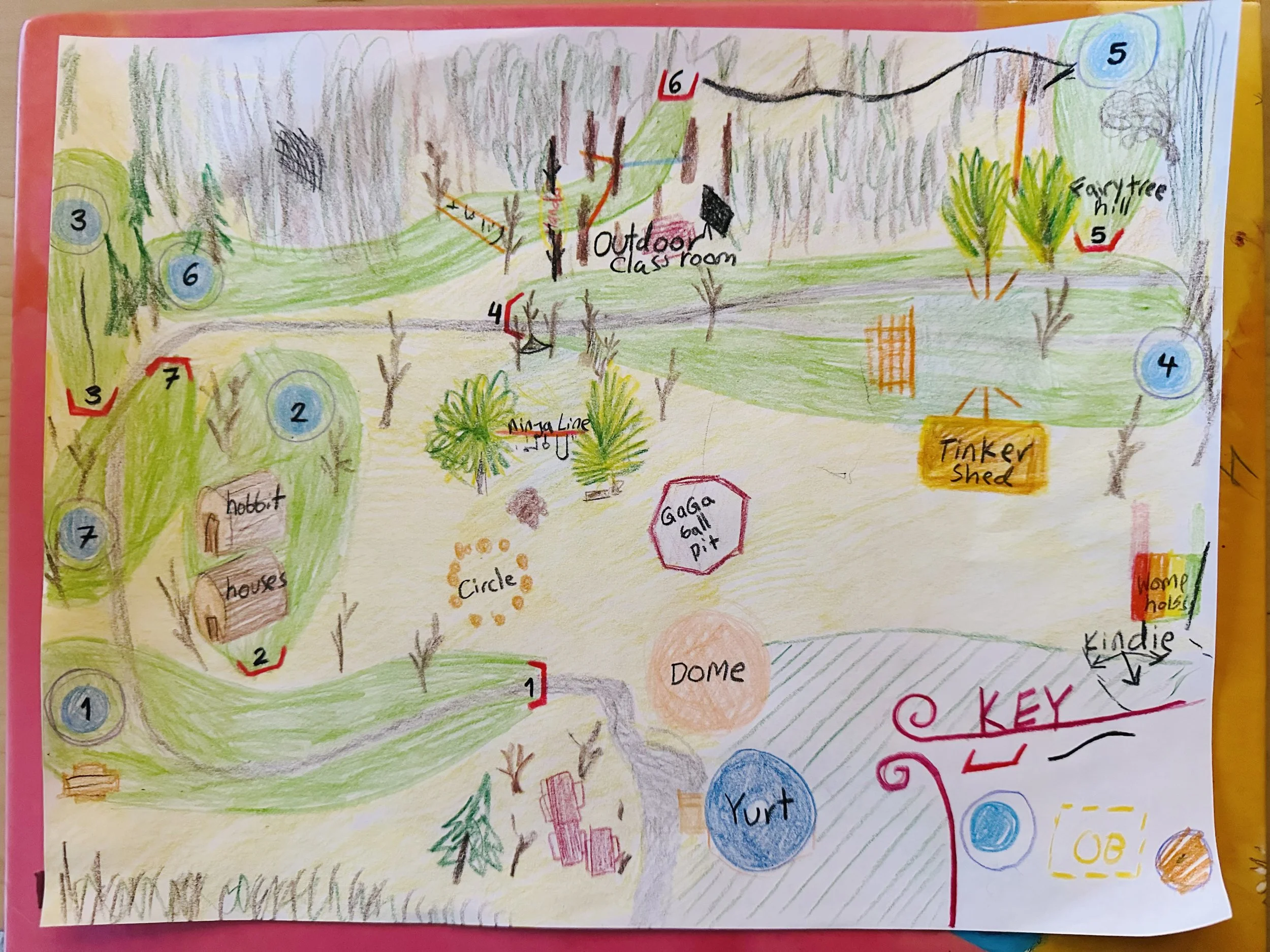
Our own map of the Hundred Acre Wood
Anyone who grew up with the books remembers the map inside the front cover - Pooh’s Hundred Acre Wood laid out in a child's hand, every important place named. When we read the books at school, that map is always where the children want to stop, point, discuss, and find their bearings.
Here is the part I never saw coming: our children and educators made their own.
Over the years, the children of HAW have named all sorts of places on the land where we play, and together with their teachers they have mapped it out. Their map. Their names. Their Hundred Acre Wood. It has become one of my favourite things we have ever made, because nobody assigned it — it grew, the way real belonging does.
This year, as we prepare to leave our first home in Heathcote, that first map is becoming something more: a piece of our history, drawn by the children who lived it. And on the new land, the next map has quietly already begun - my own kids have started suggesting names for certain stands of trees. We haven't even moved in yet and children can already see the magic of the spaces - naming them to protect them and to keep them on the map.
Rabbit days and Eeyore days
The thing about Pooh's friends is that they are all so different - and they all belong. Anxious Piglet, bouncy Tigger, gloomy Eeyore, busy Rabbit, steady Pooh. I think the reason those characters have lasted a hundred years is that we all recognize ourselves in them. I certainly do. There are days when I am a Rabbit, full of plans and energy, and days when I am an Eeyore.
Children are the same, and at HAW we welcome them in all of their emotional states. The vast array of human feelings is not a problem to be managed; it is part of the curriculum - naming feelings, being in them, and learning self-awareness, acceptance, and empathy along the way.
The forest helps, because in the forest, children can find what they need. A quiet space. A big hill to roll down. Logs to push, trees to climb, berries to pick, friends to play with. They intuitively meet their own needs, and that is where self-regulation begins.
Our style of teaching flows from the same idea: hold space, and get out of the way. Adults - with the best of intentions - can get in the way of learning. We prevent the fall, we show them how, we call out good job! And every one of those well-meant adult-isms pulls a child out of their rich world of learning, especially in the moments of difficulty where the deepest learning potential lives. Our job is to bring them to nature, keep them safe, and let nature and child develop in reciprocity. .
Building the next Hundred Acre Wood
And now we get to build the forever version.
Our new home is fifty-plus acres on the Niagara Escarpment in Grey County: mature forest that gives you the true feeling of being in the woods - which, to me, is essential - along with open fields, gardens, a farmhouse, a greenhouse, and working farm buildings. It sits in the same catchment area we have always served, which means the families who have grown up with us can stay, and the educators — who are the real magic makers of this school - can keep doing what they do.
It also lets us dream a little bigger. We hope to add farm school to our programming, where children are engaged in meaningful work in regenerative agriculture and organic food production. Imagine the map the children will draw of that.
The river that listened
I grew up alongside the Credit River, on the traditional territory of the Mississaugas of the Credit First Nation, and that is where my own relationship with the natural world began. I could get to the trails and ravines on my bike, or on my walk to school. When I had big feelings, I would sit by the river and pour my heart out. It would catch my tears, and I would feel heard. I would perch on a rock with my feet in the water, or lean against a tree, and confide in the birds.
No adult suggested any of this. No one told me to turn to nature for my mental health. It was completely innate - and we see that same instinct in children every single day at the school. We are, all of us, nature.
It is easy to assume that today's children are forming core memories in nature the way we did, the way generations before us did. The reality is that most aren't - not because the instinct is gone, but because the invitation is. More than two hundred families are on our waitlist because they want that invitation back for their children.
That is what our campaign, Small Feet, BIG Change, is really building: not a facility, but a place where a child can know a meadow, a tree, a trail - and be known by them. Our doors on the new land open in September 2027, and this community is building them together.
If you remember your own meadow - your own tree, your own long afternoon with no plan at all - come and see what we're making. Better yet, help us make it.
Because children protect what they love. And they love what they know.
Kim Edwards is the Executive Director and founder of Hundred Acre Wood, a licensed, non-profit forest school and childcare centre in Grey County, Ontario. To learn more about the Small Feet, BIG Change campaign or to support the project, visit haw.ca/donate.